CLM with AI: how to manage the contract lifecycle without losing time, money or control
Optimize contract management with AI, cut risks, costs and time. Learn how an intelligent CLM transforms your contract lifecycle.
CLM with AI: how to manage the contract lifecycle without losing time, money or control
A contract doesn’t end when it’s signed. It starts. Yet most organizations treat contracts like closed files: a shared folder, a spreadsheet with deadlines, and the memory of the person on duty.
The result is predictable. Automatic renewals go unnoticed. Obligations are breached without anyone knowing until a claim arrives. Negotiations start from scratch because no one remembers which clauses were accepted last time. Time is wasted hunting for the right version among fifteen email attachments.
Contract Lifecycle Management (CLM) is precisely about looking at the whole process, phase by phase, and deciding where time can be saved, risk reduced, and where the process needs structure before technology.
Gartner estimates that AI integration in contract management can cut cycle time by up to 40% and projects that by 2027 half of procurement contract management will be AI‑assisted. The trend is clear, but the path isn’t about buying a tool. It’s about understanding the process first.
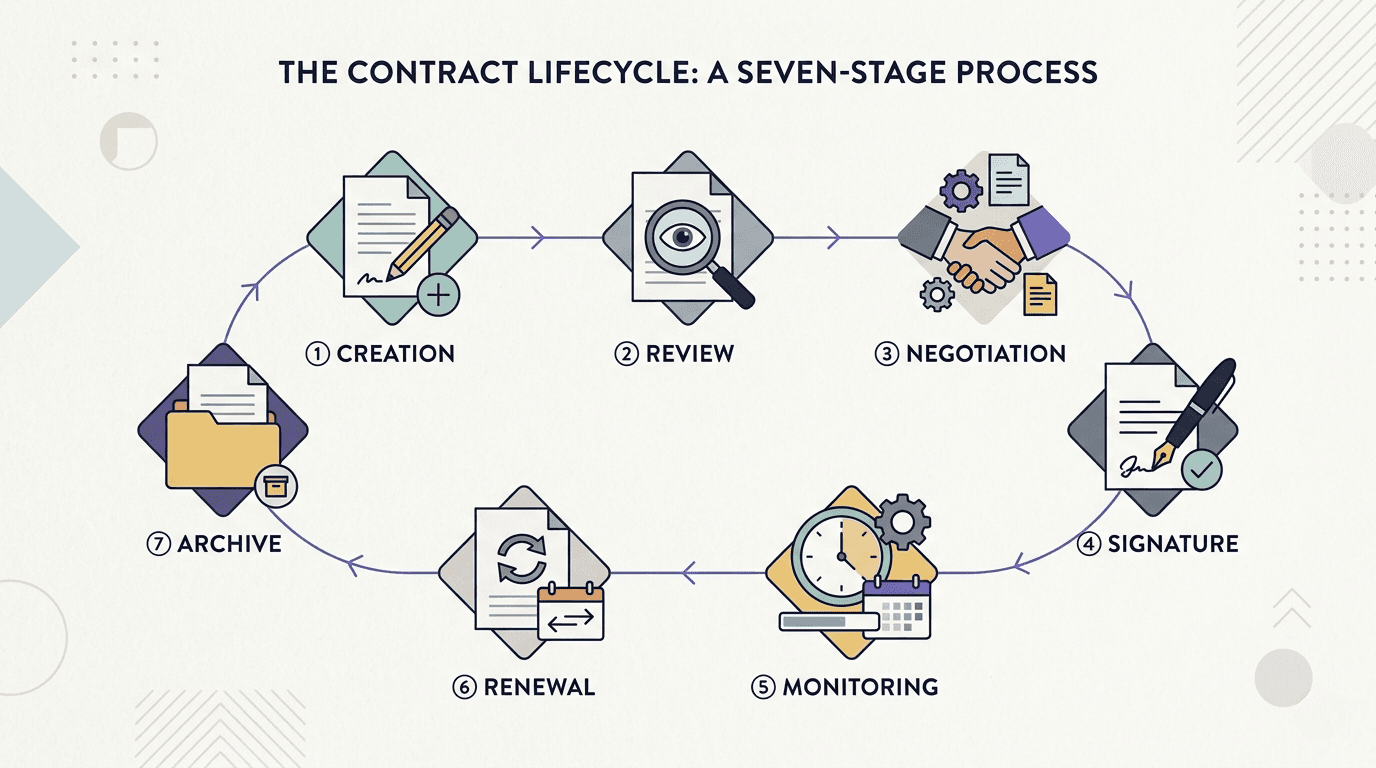
The 7 phases of a contract’s lifecycle
1. Request and initial drafting
This is where most delays begin. Business requests a contract by email, someone looks for a similar template in a shared folder, adapts it manually, and the version chain starts.
What changes with a well‑designed CLM system: a structured intake (a form with the key agreement data) that automatically triggers a first contract version from approved templates. Generative AI can fill variable clauses from the intake data and suggest standard wording for common scenarios.
The lawyer still reviews, but starts from a draft, not a blank page.
2. Review and negotiation
The most time‑expensive phase, and the one that benefits most from well‑applied AI.
An assisted‑review tool can compare the contract against the organization’s standard playbook, flag clauses that deviate, highlight known risks (liability limits, penalties, jurisdiction) and propose alternative wording.
It doesn’t replace professional judgment, but it prevents an experienced reviewer from spending two hours reading line‑by‑line to detect what the system flags in thirty seconds.
3. Internal approvals
The contract is negotiated. Now it must circulate for internal signatures: legal owner, finance if the amount exceeds a threshold, compliance if personal data is involved, senior management for large operations.
Without a system this becomes a chain of emails with manually versioned attachments. With a defined approval workflow, each stakeholder receives the document in order, sees what they need to review, gives their sign‑off, and the next link is notified automatically.
There’s no AI here, just workflow automation, but it removes the biggest source of friction with minimal technical effort.
4. Electronic signature
Electronic signing is the phase most organizations have already solved. The eIDAS regulation establishes the legal equivalence of qualified electronic signatures across the EU, and tools like DocuSign, Signaturit or Adobe Sign are embedded in almost every workflow.
The step many skip is connecting the signature to the rest of the process. When the contract is signed, it should be automatically archived in the correct repository, with metadata extracted (parties, dates, amounts, jurisdiction), and trigger follow‑up alerts.
5. Compliance with obligations and deadlines
Here lies the costliest gap. A signed contract carries obligations (deliverables, payments, notifications, automatic renewals, exit rights) that most organizations still track in spreadsheets or, worse, in the head of the person on duty.
A CLM platform extracts these obligations from the contract text at signing time and generates automatic alerts. Before a non‑renewal notice deadline passes, someone receives a warning. Before an SLA is breached, an alert pops up.
It’s not magic-structured text parsing, a database and a calendar-but at scale it prevents disputes and litigation that cost hundreds of times more than the system.
6. Renewal, amendment or closure
When a contract reaches its end, there are three paths: renew, amend, or terminate. If a structured history exists (versions, fulfilled obligations, incidents), the decision is a fifteen‑minute analysis. If not, it becomes a folder‑and‑email archaeology that can take days.
7. Archiving and leveraging history
The final step, and the most undervalued. An archived contract is not just stored paper. It’s reusable intelligence. Which liability‑limitation clauses have been accepted in the last two years with similar clients? How often has jurisdiction been ceded? What is the average payment term negotiated in the sector?
With a structured repository and semantic search (search by concept, not just keyword), the contract base becomes business intelligence. Without it, every negotiation starts from scratch.
What AI doesn’t do
AI does not decide which clauses are acceptable for a specific client-that’s the legal owner’s call. AI does not negotiate with the other party. AI does not assume professional responsibility. And AI performs poorly if the templates, playbook and organizational criteria are not documented somewhere.
This is the correct order. Before deploying CLM technology, you must be clear on what a standard contract looks like, which deviations are allowed, which obligations need tracking, and who approves what. Technology speeds up defined processes; it doesn’t invent them.
Where to start
If none of this is in place, trying to implement every phase at once is the fastest way to finish none. A reasonable entry point is to identify today’s costliest pain:
- If time is lost in repetitive negotiations over standard clauses, start with assisted review.
- If there have been scares around deadlines or automatic renewals, start with obligation extraction and alerts.
- If the team doesn’t know which version is the right one, start with structured intake and version control.
Each of these can be solved independently and deliver measurable results in three months. What doesn’t work is buying a generic platform without first deciding what problem you want to fix.
Invisibility as the goal
A well‑managed contract is invisible. It creates no friction, doesn’t get lost, expires with a notice, and doesn’t force anyone to open thirty folders to answer a question. Achieving that invisibility is what a good CLM system delivers. It isn’t flashy, but it’s where the difference between a professional operation and one merely surviving day‑to‑day becomes evident.
Sources
- Gartner. "Predicts Half of Procurement Contract Management Will Be AI‑Enabled by 2027." Gartner Newsroom, 2024.
- Gartner. "Critical Capabilities for Contract Life Cycle Management." 2024‑2026.
- Regulation (EU) 910/2014 (eIDAS) on electronic identification and trust services.
- EU AI Act – Regulation (EU) 2024/1689.
- Wolters Kluwer. "Future Ready Lawyer Report 2026."