Predictive Maintenance in Manufacturing: the Data You Need Before Applying AI
What data, signals, and operational conditions a manufacturing plant needs to implement predictive maintenance without starting with the wrong model.
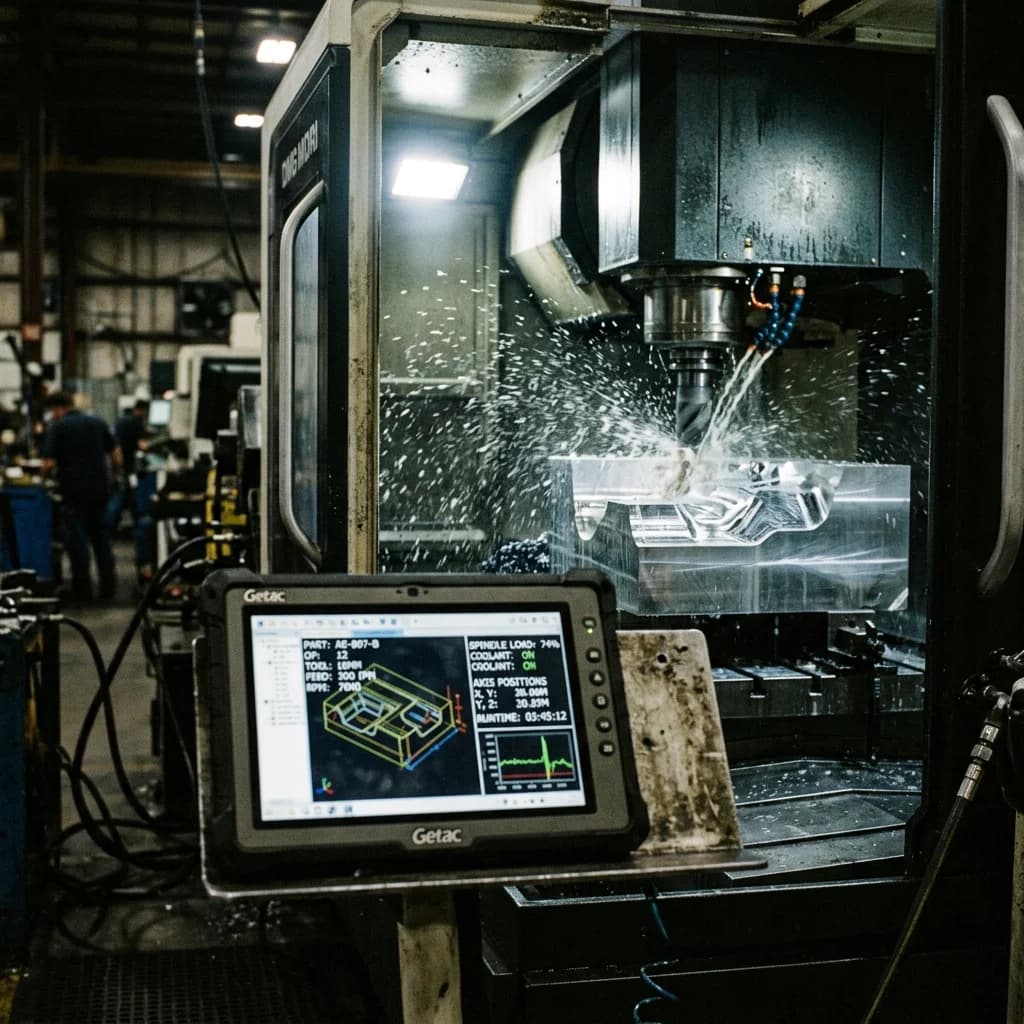
Predictive Maintenance in Manufacturing: the Data You Need Before Applying AI
Predictive maintenance promises to detect failures before they stop a production line. The idea is attractive, but many plants start by looking for an AI model before resolving the most important questions: which signal to observe, how often to capture it, and what decision to make when an anomaly appears.
AI can help, but it does not replace maintenance expertise or recover data that was never recorded. A serious project starts with the machine and the working process, not the algorithm.
Predictive does not mean guessing failures
A predictive system estimates the risk of an event within a useful time horizon. For that estimate to matter, the team must be able to act before the failure.
Predicting a breakdown ten minutes in advance is not useful if stopping the line requires two hours of coordination. A three-week warning is also ineffective if it produces so many false positives that maintenance stops trusting it.
Before discussing models, define:
- Which failure you want to anticipate.
- How much time you need to intervene.
- The cost of an unplanned stop.
- The action triggered by an alert.
- The level of error the operation can accept.
Data that usually contributes value
The right source depends on the asset. Vibration, temperature, pressure, electrical consumption, flow, speed, or cycle count may matter, but collecting every signal does not guarantee a better result.
Four groups of data are commonly combined:
Machine signals
Readings from sensors, PLCs, SCADA, or monitoring systems. The value, sampling frequency, unit, and exact capture time all matter.
Maintenance history
Work orders, replaced components, intervention type, confirmed cause, and downtime. If the history only contains notes such as “checked” or “fixed,” it must be structured before it can support a model.
Production context
Product, load, shift, recipe, speed, or environmental conditions. A temperature may be normal at full load and anomalous during a different production run.
Confirmed events and failures
The model needs reliable examples of the event it should anticipate. When failure records are inconsistent, anomaly detection with human validation may be a better first step.
Start with a critical, repeatable asset
The best pilot is not always the most expensive machine. Choose an asset with clear operational impact, enough cycles, and a failure mode the team understands well.
A machine that fails once every ten years will provide little data for a first model. A group of similar pumps, motors, or compressors makes it easier to compare behavior and learn faster.
The pilot should measure more than technical accuracy. Record how many alerts led to a useful intervention, how much warning time they provided, and which stops were avoided or planned better.
Data quality is verified on the plant floor
Before building a model, review gaps, scale changes, disconnected sensors, unsynchronized clocks, and machine modifications that were never documented.
A chart can look correct while mixing units or periods with different configurations. Maintenance, production, and data teams therefore need to review the signals together. Operational context prevents conclusions that are technically elegant but useless in practice.
Put the prediction into daily work
An isolated alert in another dashboard will be forgotten. The result should reach the system maintenance already uses: CMMS, ERP, operational email, or a plant dashboard.
A common flow looks like this:
- The system detects a relevant deviation.
- It checks load, context, and recent events.
- It creates a recommendation with supporting evidence.
- A technician validates or dismisses the alert.
- The decision and outcome are stored to improve the system.
The final step matters. Technician feedback creates the data needed to reduce false positives and adapt the model to the plant.
When rules are enough
Not every case requires machine learning. When the team knows clear limits for temperature, pressure, or consumption, a well-configured rule can solve the problem at lower cost and with greater transparency.
AI becomes useful when several signals interact, patterns depend on context, or the relationship cannot fit into a fixed threshold. A good AI and process diagnosis may conclude that a rule is sufficient. Choosing the simpler solution is also good technology judgment.
The goal is to decide earlier, not collect more data
Predictive maintenance creates value when it turns scattered signals into an operational decision with enough time to act. A project that only produces a new dashboard is not finished.
Start with a specific failure, a bounded asset, and a defined action. With that foundation, data and AI can reduce uncertainty without turning the plant into a permanent experiment.